
Home › Eloping in Ireland › Northern Ireland elopements
Elopement guide
Northern Ireland elopements on the Causeway Coast
Castle ruins, basalt cliffs and sea caves inside a forty-mile stretch of north Antrim — and a practical guide to marrying in the middle of them.
Written by David Duignan · Last reviewed 10 September 2026
The short version
A Northern Ireland elopement means marrying on the north Antrim coast between Portstewart and Cushendun — a roughly 40-mile stretch holding castle ruins, basalt cliffs, sea caves, beaches and the Giant’s Causeway. Most couples travelling from abroad choose a symbolic ceremony, having completed the legal marriage at home, because it removes every restriction on where and when they can say their vows.
- Legal notice in Northern Ireland: minimum 28 days; visitors need the correct visa first
- US and most non-EU visitors: UK Electronic Travel Authorisation, £20, required even if you fly into Dublin
- Typical coverage: six to eight hours, three to five locations
- My elopement photography: from $3,000 USD, no travel fee within Ireland
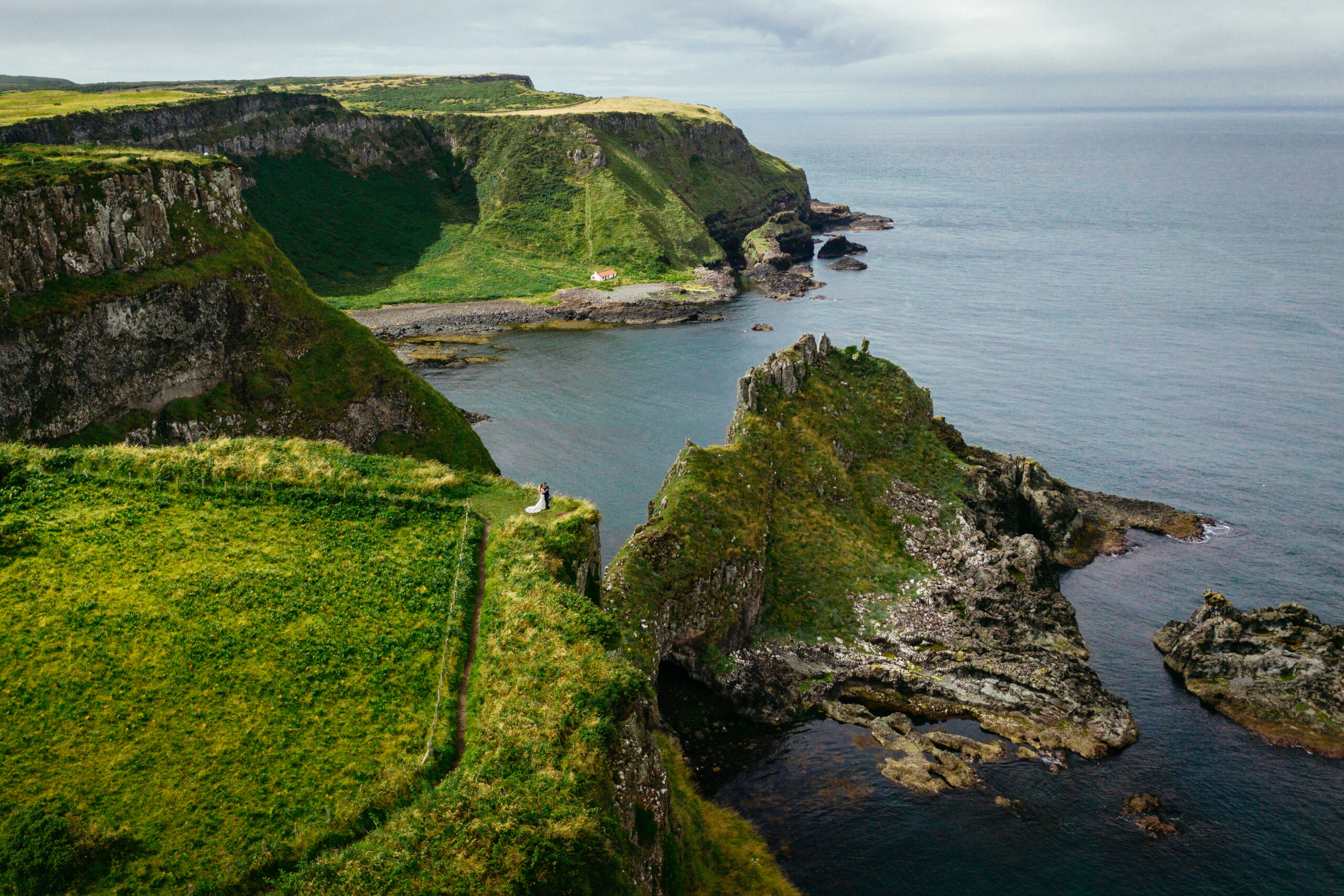
Why this particular coastline
Ireland is not short of dramatic scenery. Kerry, Donegal and Clare all have landscapes that will stop you mid-sentence. What the Causeway Coast has that they don’t is density.
In Donegal, two world-class locations can sit an hour apart on single-track road. On the north Antrim coast, Dunluce Castle to Whiterocks is a couple of minutes. Ballintoy to White Park Bay is about five. Dunseverick to the Giant’s Causeway car park is under ten. That changes the texture of a wedding day more than any single view does, because it means the day is spent standing in places rather than driving between them.
It matters a second time when conditions turn. A day built around one iconic spot has no answer to a forty-knot westerly. A day built on this coast has four answers, and the nearest one is usually a few minutes away and facing a different direction.
Two ways to be married here
Almost everyone who contacts me about a Northern Ireland elopement is deciding between the same two routes, and the choice shapes everything that follows.
| Legal marriage in Northern Ireland | Symbolic ceremony | |
|---|---|---|
| Notice period | 28 days minimum, given within the 12 months before the date | None |
| Visa (non-UK/EEA) | Correct visa required before travelling and before giving notice | Standard visitor entry with an ETA |
| Where you can marry | Registrar or authorised officiant must agree the venue | Anywhere you can lawfully stand |
| Witnesses | Two required | Not required |
| Paperwork on the day | Marriage schedule signed and returned | None |
| Who it suits | Couples who want the certificate to say County Antrim | Most couples travelling from abroad |
Neither is more real than the other. A symbolic ceremony is a wedding in every sense that matters to the people standing in it — it simply isn’t the instrument that changes your legal status. The full process for both, including documents and immigration status statements, is on the legal requirements page.
How a day here usually runs
There’s no fixed template, but a six-to-eight-hour Causeway Coast elopement tends to fall into a recognisable shape.
- Morning, wherever you’re staying. Getting ready somewhere with decent windows makes a real difference to the first hour of photographs.
- One location before the ceremony. Somewhere sheltered and quiet — a first look, or just twenty minutes to stop feeling like you’re about to be looked at.
- The ceremony. Fifteen to thirty minutes of actual ceremony, an hour or so at the location once portraits are included.
- Food. Genuinely important. A harbour chipper, a picnic, or a table booked somewhere warm. The middle of the day is when adrenaline runs out.
- Two or three more locations into the evening. This is where the photographs you’ll print tend to happen.
The planning detail — light windows by season, how the wind behaves, what to wear, where to base yourselves — is on the planning page.
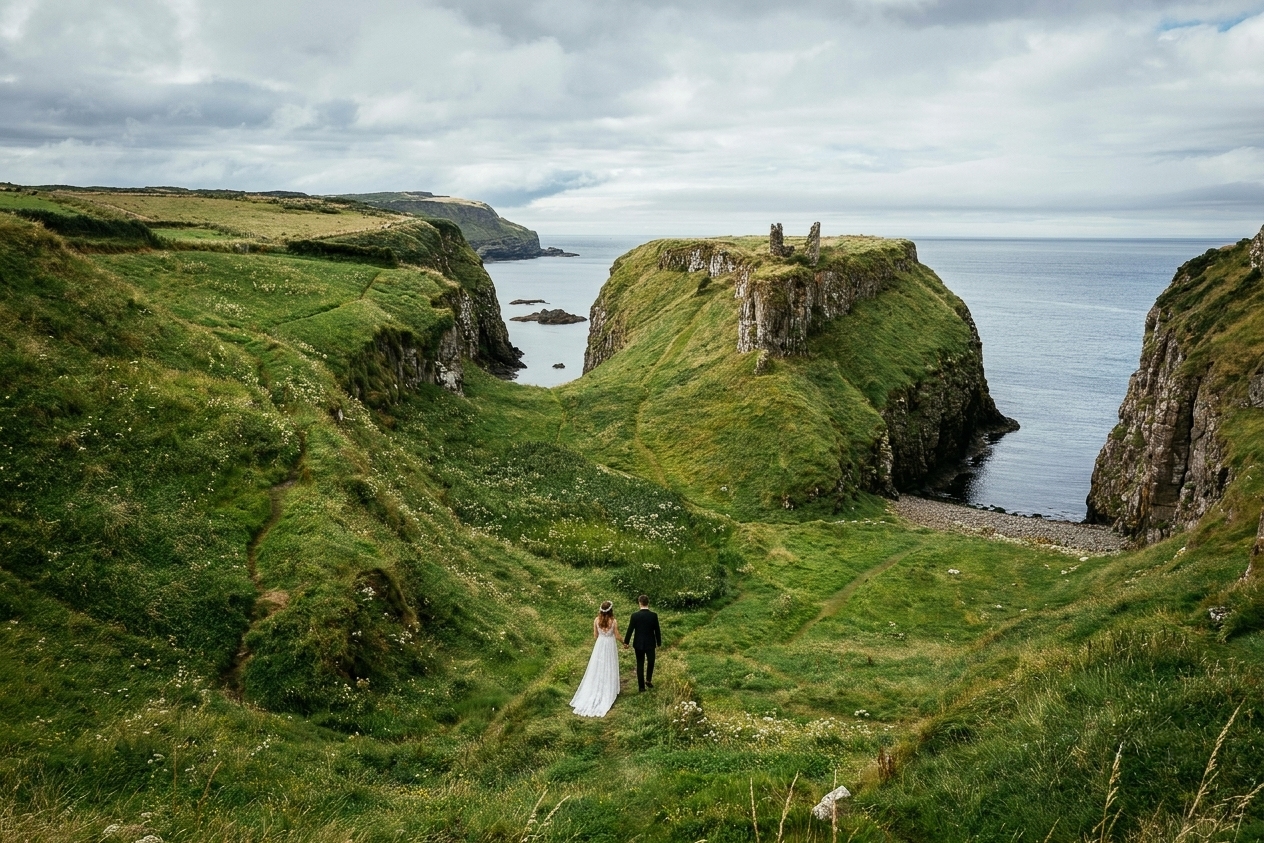
Where couples actually say their vows
Three castle ruins carry most of the ceremonies on this coast, and each one asks something different of you.
Beyond the castles there are beaches, sea caves, a waterfall that drops straight into the Atlantic and the Causeway stones themselves. All of them, with drive times and the light each one wants, are on the Causeway Coast locations page.
What it costs
My elopement photography starts at $3,000 USD, and there’s no travel charge anywhere in Ireland. Beyond that, the figures below are the ranges couples I’ve worked with actually report for a Northern Ireland trip. They’re planning estimates, not quotes.
One note on currency, because this trips people up on a trip that crosses a border. My fee is quoted in US dollars. Suppliers on the Causeway Coast bill in pounds sterling, since Northern Ireland is in the UK. Anything you book in the Republic — a Dublin hotel on the way up, for instance — will be in euro.
| Item | Typical range | Notes |
|---|---|---|
| Photography | from $3,000 USD | Six to eight hours is the usual booking |
| Celebrant or officiant | £300–£700 | Higher for a legally authorised officiant |
| Hair and makeup | £250–£600 | Rural coast, so travel is often added |
| Flowers | £150–£450 | Loose and seasonal holds up far better in wind |
| Private land access | £250–£600 | Only some locations; confirmed with the landowner in advance |
| Accommodation | £120–£400 per night | Bushmills, Portballintrae, Portrush, Ballycastle |
| Car hire | £45–£90 per day | Book automatic well ahead; most rentals here are manual |
| UK ETA | £20 per person | Valid two years, multiple entries |
Getting here from abroad
Dublin has the most direct transatlantic flights and is about two and a half hours from Bushmills on good road. Belfast International is a little under an hour from the coast and is the better landing if the flights work. Either way, hire a car — this is not a coastline that public transport serves usefully on a wedding day.
The border catches people out
There is no physical border between the Republic and Northern Ireland, and you will cross it without noticing. Three things change anyway: the currency goes from euro to pounds sterling, speed limit signs go from km/h to mph, and the UK ETA requirement applies from the moment you’re in Northern Ireland — including if you landed in Dublin and drove north. Check your mobile plan too, since a package covering “Ireland” or “Europe” may not cover the UK.
Common questions
Do we have to be Irish or live in Ireland to elope in Northern Ireland?
No. There is no residency requirement. Couples travel from the United States, Canada and mainland Europe to marry on the Causeway Coast every year. You either follow the Northern Ireland notice process, or you complete the legal marriage at home and hold a ceremony here that carries no paperwork.
Do Americans need a visa to elope in Northern Ireland?
It depends on what kind of ceremony you are having. For a holiday, including a symbolic ceremony with no legal effect, US citizens need a UK Electronic Travel Authorisation. If you intend the marriage itself to be legally registered in Northern Ireland, that is not a visitor activity, and nidirect states you must hold the correct visa — usually a Marriage Visitor visa — before you travel and before you give notice.
How much of the day should we book?
Most Causeway Coast elopements work best at six to eight hours. That covers getting ready, the ceremony, a proper break to eat, and three or four locations in good evening light without anyone watching a clock.
Can we bring a few guests?
Yes, and plenty of couples bring parents or two close friends. Numbers change the location list more than anything else. Some headlands take a couple comfortably and a group of ten badly, so tell me the number early and I will shape the day around it.
Is it going to rain?
Some of the time, probably. North Antrim weather moves quickly, which means showers pass rather than settle in. The practical answer is to build the day with sheltered alternatives close by, rather than to hope for a clear forecast.
What if the weather is too bad for the location we picked?
We move. The whole reason this coastline suits elopements is that a strong alternative is usually five to fifteen minutes away, which is not true of most scenic regions in Ireland.
Do you charge extra to travel to the Causeway Coast?
No. There is no travel fee for elopements anywhere in Ireland.
How far ahead should we book?
For a symbolic ceremony, a few weeks is genuinely workable. For a legal marriage in Northern Ireland, the 28-day notice period plus visa processing sets the floor, so eight to twelve weeks is a more comfortable minimum.
Official sources used on this page
- nidirect — Getting married in Northern Ireland
- nidirect — Visiting Northern Ireland to marry
- GOV.UK — Apply for an Electronic Travel Authorisation
- HSE — How to get married in Ireland
Fees and notice periods change. Always confirm the current position with the registrar or on GOV.UK before you book flights.
Where to go next
Thinking about the Causeway Coast?
Tell me your dates and roughly what you’re picturing. I’ll come back with honest thoughts on whether it works, and what I’d do differently.
Check my availability