
Home › Eloping in Ireland › Northern Ireland elopements › Kinbane Castle
Location guide
Kinbane Castle elopements
A 1547 ruin on a white limestone spur near Ballycastle, reached by 140 cliff steps — the most dramatic of the Causeway castles, and the most demanding.
Written by David Duignan · Last reviewed 10 September 2026
The short version
Kinbane Castle is a 1547 ruin on a narrow white limestone spur near Ballycastle, reached by around 140 steep cliff steps. That descent is why it stays quiet, and why it isn’t right for everyone. Access is free and small ceremonies don’t generally need a permit. Because there’s no quick exit and almost no shelter on the headland, a backup location nearby is not optional here.
- Where
- Kinbane Head, near Ballycastle, County Antrim
- Nearest town
- Ballycastle, about ten minutes
- Ceremony spot
- The valley overlook, or out at the ruins on the headland
- Access
- Free; car park at the clifftop, then around 140 steps
- Walk
- 10–15 min down, 10–20 min back up
- Group size
- Couple only, or a very small mobile group
- Best light
- Late afternoon into sunset, or dawn
- Managed by
- Causeway Coast and Glens Borough Council
What makes it worth the steps
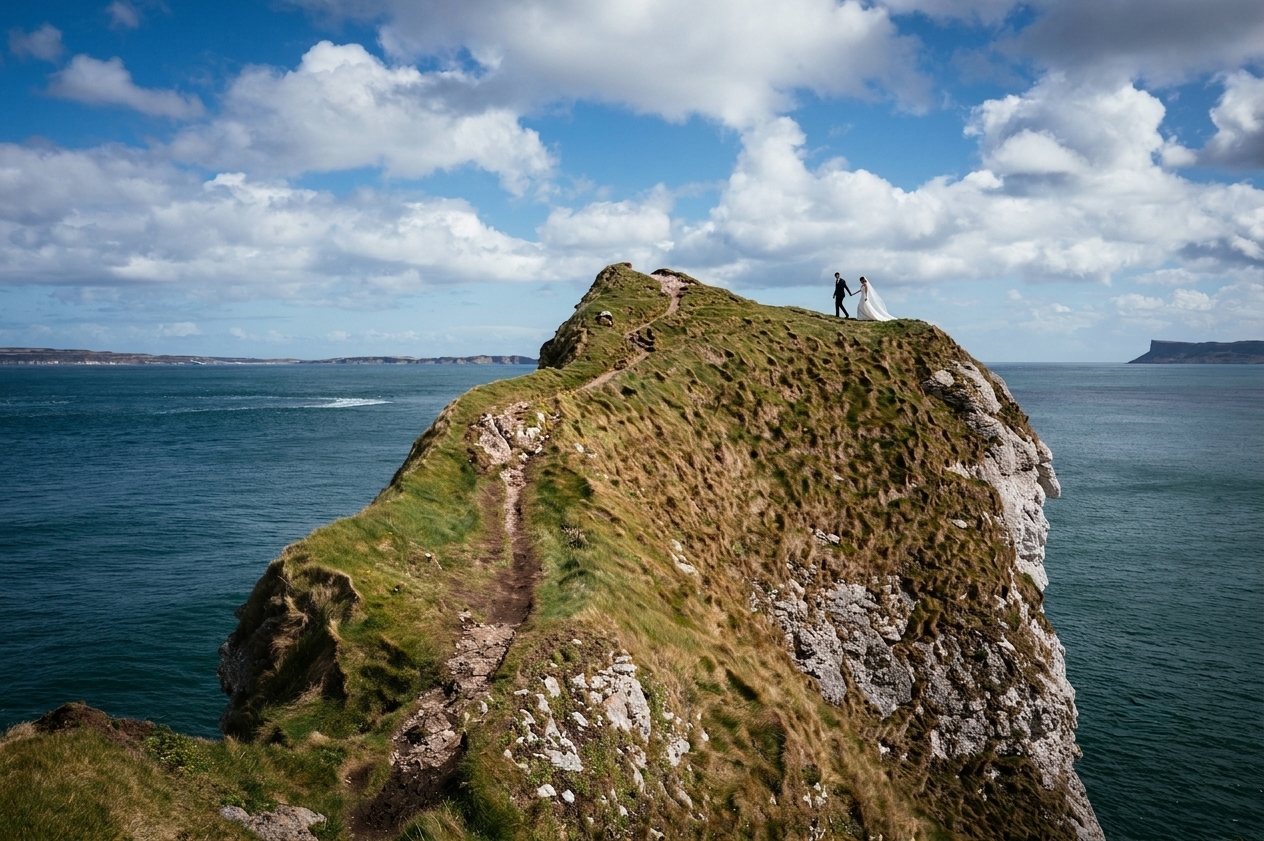
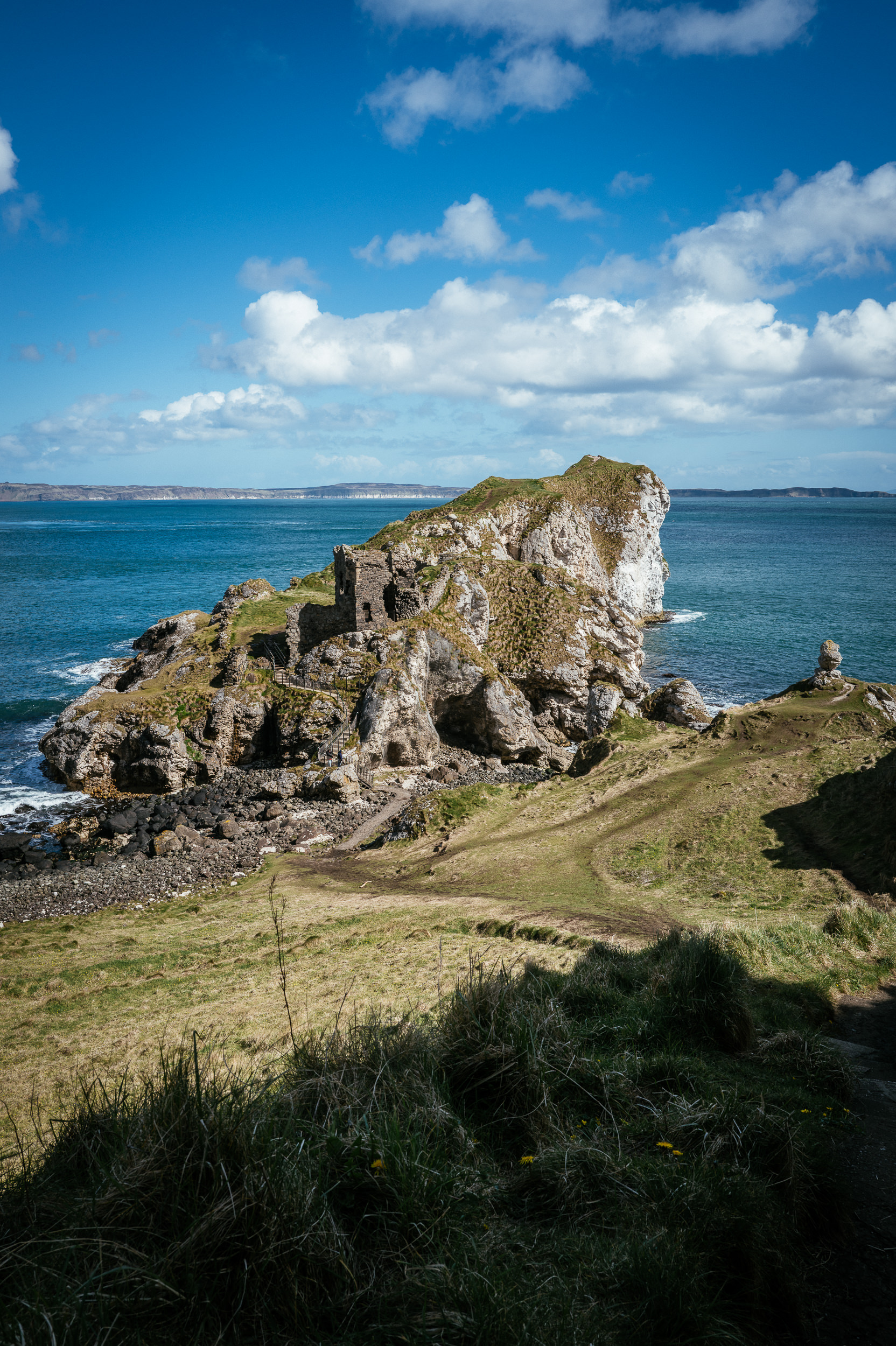
Kinbane is the most physically demanding of the three Causeway castles and, for a certain kind of couple, the most rewarding. The ruin sits on a thin finger of rock pushing out into the sea, wrapped by white limestone cliffs that give the place its name. On a clear day you can see across the North Channel towards Scotland. On a wild one the Atlantic hammers the base of the cliffs while the sky changes every few minutes.
The walk is part of it. By the time you reach the bottom you’ve left the car park, the road and everything ordinary behind you, and the ceremony starts from a different place emotionally than it would if you’d parked twenty metres away. It also does something entirely practical: almost nobody makes the descent, so even in high season the headland tends to be yours.
Where the ceremony happens
The valley overlook
The one I recommend most often. It sits partway down, on much flatter ground, with the castle out on the headland behind you for the whole ceremony. Standing slightly downhill of a couple puts the ruin higher on the horizon, which is one of the better natural compositions anywhere on this coast.
Out at the ruins
Fully exposed, sea on three sides, and about as immersive as an outdoor ceremony gets in Ireland. It suits two people and steady footing. It does not suit a group, and it does not suit a strong westerly.
Kinbane is the one location where I insist on a plan B
The ruins are open to the weather, so they give you no real cover, and getting back to the car takes twenty minutes even moving quickly. If a front arrives while you’re out on the headland, you sit in it. That’s manageable if it was expected and miserable if it wasn’t. I always hold a second location — usually Ballintoy Harbour, five minutes away, or Cushendun Caves — and we decide on the morning rather than on the clifftop.
The history, briefly
Colla MacDonnell built the castle in 1547 on a site that had almost certainly been used long before. It was part of the MacDonnell network of coastal strongholds along this shore and was attacked and rebuilt more than once. What survives is fragmentary, weathered and entirely unrestored, which is exactly what makes it photograph the way it does.
Practical notes
- Footwear that grips. The slopes get slick after rain and the steps are steep. Walk down in boots and change at the bottom.
- Allow real time. Budget forty minutes for the round trip on foot before you’ve taken a single photograph.
- Keep numbers down. This is a place for two people and maybe a couple more, not a wedding party.
- Layers. The wind on that spur is a different proposition from the car park.
- Signal is unreliable. Download offline maps before you set off.
Building a day around it
Kinbane sits in the eastern half of the coast. Ballintoy is five minutes, White Park Bay about ten, Murlough Bay twenty and Dunseverick around twenty. Basing yourselves in Ballycastle puts you closest to all of it.
Because the descent and climb take time, Kinbane works best as either the centrepiece of the day or the final stop for sunset — not as one of five quick moves. Give it two hours and it will fill them without repeating itself.
Common questions
Do you need a permit to elope at Kinbane Castle?
Small ceremonies don’t generally require a permit. The site is managed by Causeway Coast and Glens Borough Council, so it’s worth checking the current position with them if you’re bringing more than a handful of people.
How difficult is the walk down to Kinbane Castle?
There are around 140 steep steps from the car park down the cliff, then grass out to the headland. The descent takes ten to fifteen minutes. The climb back up takes ten to twenty depending on fitness, and it’s the part people underestimate.
Is Kinbane suitable for guests?
Only for a very small, mobile group. The steps and the narrow headland make it a poor choice for anyone with mobility or fitness concerns, and for larger parties. Dunseverick is the better option in that case.
Why does Kinbane need a backup plan?
Because there’s no quick way out. Once you’re on the headland you’re twenty minutes from the car park, the ruins offer almost no real shelter, and the whole spur is exposed to the Atlantic. If the weather turns, you’re committed to it. I always hold an alternative nearby.
What are the best backup locations near Kinbane?
Ballintoy Harbour is five minutes away and has cover and easy parking. Cushendun Caves are genuinely weatherproof. White Park Bay and Dunseverick both work as well.
When is the best time of day at Kinbane?
Late afternoon into sunset, or dawn if you’re willing to start hair and makeup around five in the morning. The pale limestone reflects light back beautifully in the softer hours.
How old is Kinbane Castle?
It was built in 1547 by Colla MacDonnell, part of the MacDonnell family’s network of coastal strongholds. The name comes from the Irish Ceann Bán — white head — after the limestone cliffs around the peninsula.
Is Kinbane ever crowded?
Rarely. The steps do the filtering. Even on days when the rest of the coast is busy, the headland is usually quiet.
Up for the steps?
Send me your date and I’ll tell you what the light and the tide are doing, and which backup I’d hold alongside it.
Check my availability