
Home › Eloping in Ireland › Northern Ireland elopements › Causeway Coast locations
Location guide
Causeway Coast elopement locations
Fourteen places on the north Antrim coast where couples actually say their vows — what each one is for, when it works, and which ones need permission.
Written by David Duignan · Last reviewed 10 September 2026
The short version
Almost every Causeway Coast elopement is built from the fourteen locations below, running east to west from the Glens of Antrim to Mussenden Temple. Most sit within five to twenty minutes of the next one. Three of them — the Dunluce clifftop field, the Giant’s Causeway and several working farms — need permission arranged in advance. The rest are open access.
How to read this list
A location isn’t good or bad on its own — it’s good or bad at a particular hour, in a particular wind, at a particular time of year. A west-facing clifftop is extraordinary at sunset and flat at eleven in the morning. A sea cave is a gift in horizontal rain and dull in flat sunshine. So each entry below says what the place is for, and when it wants to be visited.
Distances are the other half of it. What makes this coast unusual is how close everything sits together, which is why a day here can move through four or five genuinely different landscapes without anyone spending the evening in a car.
Fourteen places to say your vows
1. Glens of Antrim and Glenariff
Inland green, waterfalls and steep-sided valleys. Real shelter when the coast is being battered, and a completely different look to everything else on this list. Best for: woodland ceremonies, wind contingency. Time: morning or overcast afternoon.
2. Cushendun Caves
Red conglomerate sea caves at the mouth of the Glendun river, carved out over roughly 400 million years. Genuinely weatherproof, which makes them one of the most useful backup locations on the coast. Best for: rain, drama, privacy. Time: any hour, tide permitting.
3. Murlough Bay
A steep single-track road drops you into one of the quietest bays in the north, under Fair Head. Big, silent and almost always empty. Best for: solitude and scale. Time: sunrise or late afternoon.
4. Kinbane Castle and Kinbane Head
A ruined tower on a white limestone spur running out into the sea, reached by around 140 steps down the cliff. The walk keeps almost everyone away. Full Kinbane Castle guide. Best for: couples who want to earn the view. Time: late afternoon to sunset, or dawn.
5. Carrick-a-Rede and Larrybane
The rope bridge gets the attention; the chalk quarry and headland beside it are the better photograph and far quieter. Best for: short, high-impact portraits. Time: late afternoon.
6. Ballintoy Harbour
A tiny working harbour below a steep hairpin road, with black basalt stacks offshore. It has cover, parking close by and character in any weather, which is why it ends up as a fallback so often. Best for: accessibility and bad-weather days. Time: early morning or evening.
7. Elephant Rock and the Ballintoy shore
A natural arch on the shoreline west of the harbour, on farmland. Access is by arrangement with the landowner. Best for: adventurous portraits, private vows. Time: late afternoon.
8. White Park Bay
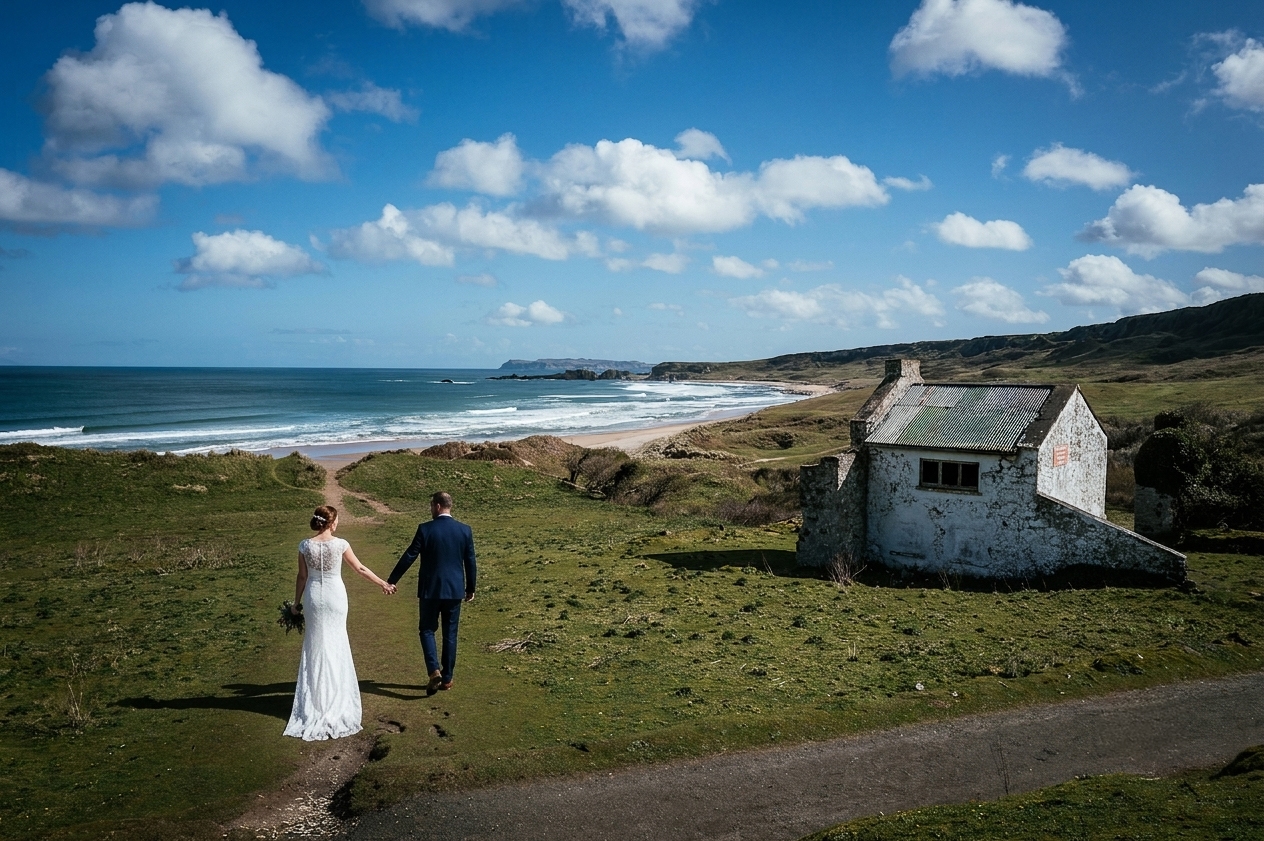
A mile-long sweep of sand between headlands, backed by dunes and grazed by cattle that genuinely do wander onto the beach. The descent from the car park is steep. Best for: open, wandering coverage. Time: sunrise or evening.
9. Dunseverick Falls
A small waterfall dropping over black rock straight into the Atlantic, two minutes from Dunseverick Castle. Compact, easy and unlike anything else on the coast. Best for: variety in twenty minutes. Time: overcast or golden hour.
10. Dunseverick Castle
Ancient ruins on a promontory, National Trust land since 1962, and the quietest of the three castles. The valley below the headland is where most ceremonies happen. Full Dunseverick Castle guide. Best for: calm ceremonies with a few guests. Time: late afternoon.
11. The Causeway cliff path and Hamilton’s Seat
The clifftop path between Dunseverick and the Causeway looks down on the whole basalt coastline and carries a fraction of the traffic the stones do. Walking the full stretch is a five-hour commitment once you account for stopping. Best for: hikers. Time: late afternoon into sunset.
12. The Giant’s Causeway
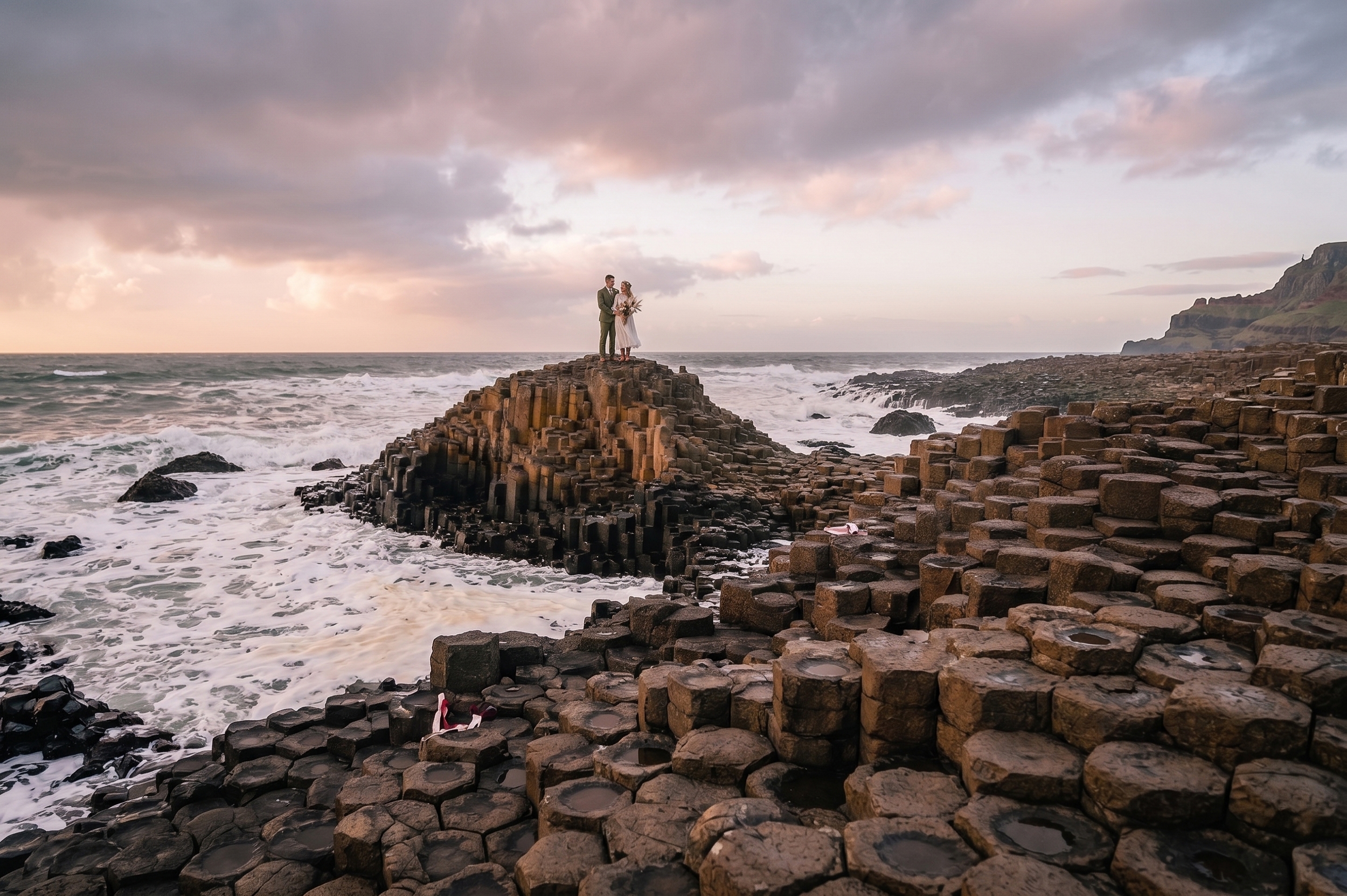
Forty thousand interlocking basalt columns, a UNESCO World Heritage Site, and the single busiest place on this list. It is entirely doable if you go early or late and arrange permission with the National Trust first. Best for: the shot you came for. Time: before opening or after closing.
13. Dunluce Castle
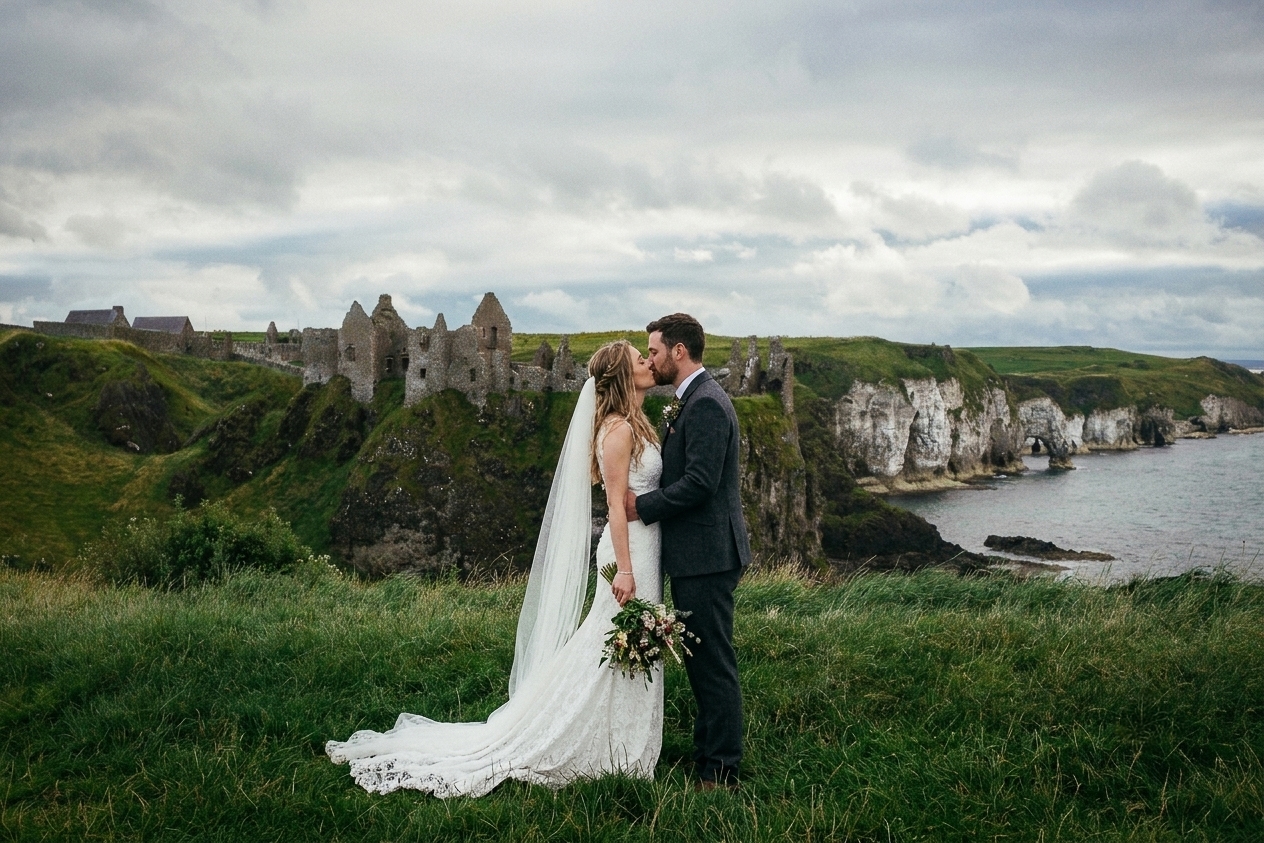
A 16th-century ruin on a sea stack with a cave running underneath it. The classic wide view is from private farmland alongside, booked in advance. Full Dunluce Castle guide. Best for: the most recognisable castle ceremony on the coast. Time: late afternoon to sunset.
14. Whiterocks and Mussenden Temple
Whiterocks is a minute from Dunluce — pale limestone cliffs and a long beach. Mussenden Temple, half an hour further west at Downhill, is a small classical rotunda on a cliff edge above Benone Strand, and makes a natural closing location. Best for: the last hour of light. Time: sunset.
Drive times along the coast
| From | To | Approx. |
|---|---|---|
| Glenariff | Cushendun Caves | 20 min |
| Cushendun | Murlough Bay | 25 min |
| Murlough Bay | Kinbane Castle | 20 min |
| Kinbane Castle | Carrick-a-Rede / Larrybane | 5 min |
| Larrybane | Ballintoy Harbour | 4 min |
| Ballintoy | White Park Bay | 5 min |
| White Park Bay | Dunseverick Castle | 6 min |
| Dunseverick Castle | Giant’s Causeway | 10 min |
| Giant’s Causeway | Dunluce Castle | 12 min |
| Dunluce Castle | Whiterocks | 2 min |
| Whiterocks | Mussenden Temple | 30 min |
Add time in July and August, and on any day with a tractor in front of you. The Antrim Coast Road is not a road to hurry on, and you wouldn’t want to.
Access, permission and doing this properly
Northern Ireland doesn’t work like a US national park, where access is broadly assumed. Ownership along this coast is a patchwork of National Trust land, council-managed monuments, state care sites and working farms, and the rules differ site by site.
- Open access, no fee: Dunseverick Castle, Kinbane Head, Ballintoy Harbour, White Park Bay, Murlough Bay, Cushendun Caves, Whiterocks.
- Pre-booked and paid: the private clifftop field beside Dunluce Castle; the Dunluce ruins themselves during opening hours.
- Arranged with the National Trust: ceremonies and commercial photography at the Giant’s Causeway and Carrick-a-Rede.
- Landowner permission: Elephant Rock and several field and headland spots that look public online and are not.
Turning up at a private site without an arrangement is the most common way a well-planned elopement day comes apart. It’s also completely avoidable with a phone call weeks earlier.
Common questions
How many locations can we realistically visit in one day?
Three to five is the sweet spot for a six-to-eight-hour day. More than that and you spend the evening moving rather than being anywhere. Two large sites like Murlough Bay or Kinbane can absorb two hours each on their own.
Which Causeway Coast locations need permission?
The clifftop farmland beside Dunluce Castle is private and must be booked and paid for in advance. Ceremonies and commercial photography at the Giant’s Causeway need to be arranged with the National Trust. Several field and headland spots are on working farms and are only accessible by asking the farmer. Dunseverick and Kinbane are open access.
Can we have a ceremony at the Giant’s Causeway itself?
It’s possible but it needs planning around the crowds. The stones are busy through the middle of the day from late spring to early autumn, so early morning or after the site closes are the realistic windows. Permission is arranged with the National Trust in advance.
Are the Dark Hedges good for a ceremony?
For portraits, yes, especially at first light. For a ceremony, no. It’s a narrow public avenue with people on it at almost any hour, and there are much better options within twenty minutes.
Which location is best if someone in the group can’t walk far?
Dunseverick’s upper viewpoint, Ballintoy Harbour and Whiterocks all sit close to parking. Avoid Kinbane, which involves around 140 steep steps in each direction.
Do you have backup locations for bad weather?
Always, and they’re chosen for the wind direction rather than picked off a list. Cushendun Caves, the sheltered valley below Dunseverick and Ballintoy Harbour all work when exposed clifftops don’t.
Not sure which of these is yours?
Send me your dates and the number of people, and I’ll suggest a route that suits the light and the season rather than a list off the internet.
Check my availability