
Home › Eloping in Ireland › Northern Ireland elopements › Dunseverick Castle
Location guide
Dunseverick Castle elopements
An ancient promontory site ten minutes from the Giant’s Causeway — freely accessible, sheltered, and the quietest of the three Causeway castles.
Written by David Duignan · Last reviewed 10 September 2026
The short version
Dunseverick Castle is an ancient promontory site on the Causeway Coast, ten minutes east of the Giant’s Causeway. It’s National Trust land and freely accessible, with no gates, staff or fees. Most ceremonies happen in the sheltered valley below the ruins rather than up on the headland, because the castle then sits above and behind you. It is the easiest and quietest of the three Causeway castles.
- Where
- Causeway Road, near Dunseverick village — ten minutes from Bushmills
- Nearest airport
- Belfast International, about an hour
- Ceremony spot
- The valley below the headland, or the ruins themselves
- Access
- Free and open. Small roadside parking area on the Causeway Coast Way
- Walk
- Roughly 8–10 minutes on uneven grass and slopes
- Group size
- Best up to about 10 people
- Best light
- Late afternoon into sunset, or sunrise for complete solitude
- Managed by
- The National Trust; a Scheduled Historic Monument
Why couples choose it
Dunseverick is the answer for people who looked at the Giant’s Causeway, saw the visitor numbers, and wondered whether there was somewhere on this coast that felt genuinely private. There is, and it’s ten minutes down the road.
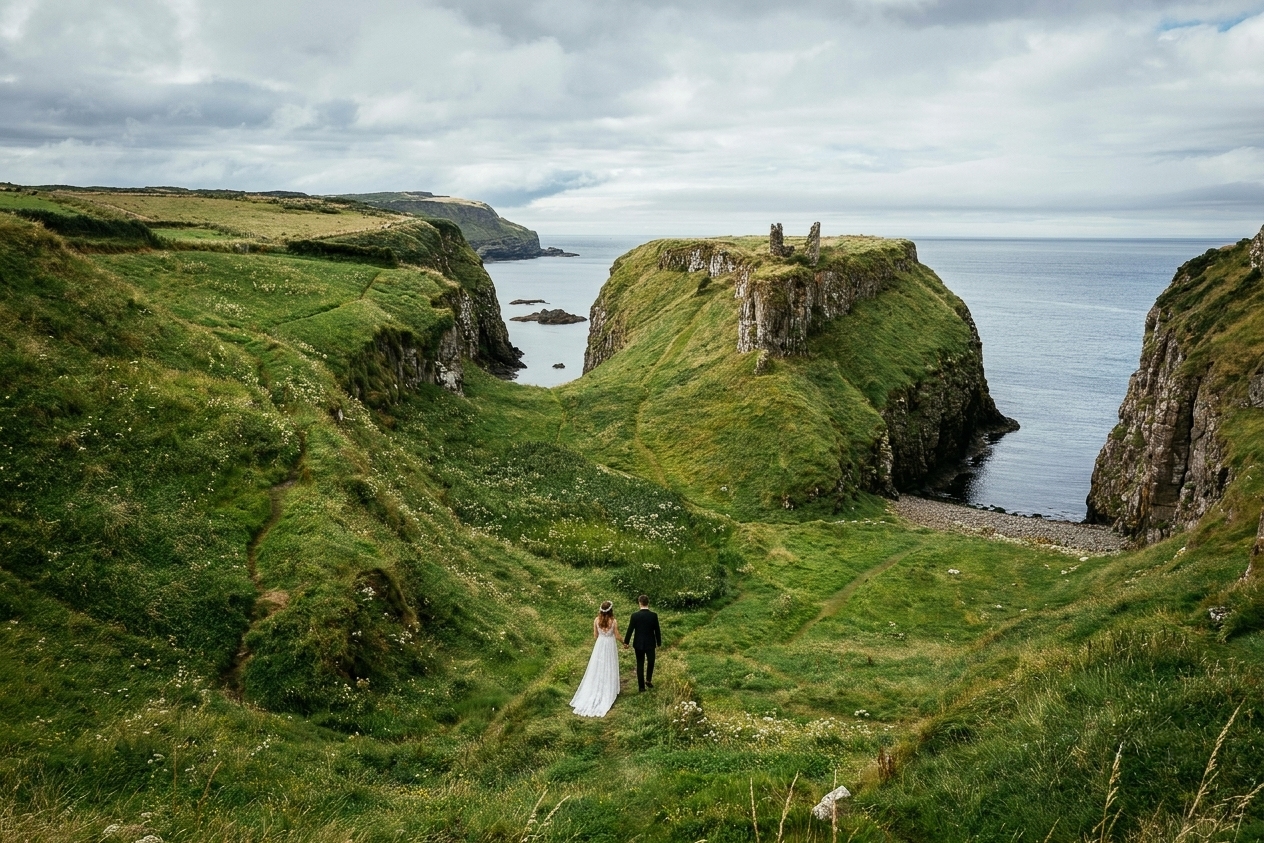
The ruins sit on a narrow rocky promontory with sea on three sides. What’s left of the castle is fragmentary — wall stubs and overgrown foundations — and that’s part of the appeal. Nothing has been tidied. You’re standing on a site that was fortified fifteen hundred years ago, on a headland the Atlantic is still working on, and it feels like it.
The valley behind the headland also gives something the rest of this coast is short of: natural shelter. When the wind is up, that dip in the ground is the difference between a ceremony you can hear and one you can’t.
Where to actually stand
The valley below the ruins
My usual recommendation, and the one most couples choose once they’ve seen it. You stand on flatter ground with the castle rising on the headland behind you. It’s a better composition than the reverse, it’s easier for anyone who came with you, and it’s more sheltered.
The headland itself
More exposed, more dramatic, and better suited to just the two of you. Sea on three sides and nothing between you and the horizon. Worth doing for portraits even if the vows happen down below.
The upper clifftop viewpoint
Close to the parking, no descent required, and still a full Atlantic view. This is the option if someone in the group can’t manage the slopes.
The history, briefly
Dunseverick — Dún Sobhairce — was a royal site of the Dál Riada, the kingdom that spanned north Antrim and western Scotland. Traces of an Iron Age promontory fort survive, and the site is traditionally the northern terminus of one of the five great roads of Ireland running from Tara. Saint Patrick is recorded as having visited in the 5th century. It was raided by Vikings in the 9th century, later held by the O’Cahans and the MacDonnells, and destroyed in the 1650s. A small residential tower survived until 1978, when it collapsed into the sea.
In 1962 a local farmer, Jack McCurdy, gave the castle and its peninsula to the National Trust, which is why it’s open to anyone who wants to walk down to it.
It’s a working landscape
There’s no visitor centre and no staff, but there are usually sheep. I’ve had a flock make themselves heard partway through a ceremony more than once, and every couple it’s happened to has told me afterwards it was their favourite part. Leave gates as you find them and take everything out with you.
Building a day around it
Dunseverick’s position is one of its strongest arguments. Dunseverick Falls is a two-minute drive, White Park Bay about six, the Giant’s Causeway ten and Ballintoy fifteen. The clifftop path towards the Causeway starts here too, and the first stretch out to Hamilton’s Seat is one of the great short coastal walks in the north.
A straightforward route: get ready near Bushmills, first look at White Park Bay, ceremony in the valley here in the late afternoon, portraits at Dunseverick Falls, then Ballintoy or Kinbane for the last of the light.
Common questions
Do you need permission to elope at Dunseverick Castle?
No. Dunseverick Castle and the promontory it stands on were given to the National Trust in 1962 and the site is freely accessible. There’s no ticket office, no gate and no staff. Keep groups small and be respectful of a working landscape and you’re fine.
Where exactly do ceremonies happen at Dunseverick?
Most take place in the valley below the ruins rather than up on the headland itself. Standing in the valley puts the castle above and behind you, which is a stronger backdrop than standing at the ruins and looking out — and the ground is far kinder underfoot.
How long is the walk?
About eight to ten minutes from the roadside parking, down into the valley and up onto the headland. The ground is uneven grass with natural slopes, so grip matters, particularly after rain.
Is Dunseverick busy?
Much less than the Giant’s Causeway or Dunluce. It’s on the Causeway Coast Way, so walkers pass through, but it’s rarely crowded even in summer.
Is it suitable for guests?
It works well for up to about ten people. For anyone who can’t manage the slopes, the upper clifftop viewpoint near the parking still gives a full Atlantic view without the descent.
How old is Dunseverick Castle?
The site is genuinely ancient — an Iron Age promontory fort, later associated with the kingdom of Dál Riada, and traditionally the northern end of one of the great roads of Ireland. Saint Patrick is recorded as having visited in the 5th century. The surviving stonework is much later, and a residential tower stood until it collapsed into the sea in 1978.
What’s nearby?
Dunseverick Falls is two minutes away, White Park Bay about six, the Giant’s Causeway ten, and the clifftop path to the Causeway starts here. It’s one of the best-connected spots on the coast.
Dunseverick sound like yours?
Tell me your date and how many people are coming. I’ll sketch a route that uses the valley, the falls and the light properly.
Check my availability